


Kyta Platform Helps Enterprises Take Control of Their Electronic Labor Contract Roadmap
09 Tháng 06 , 2026 - phút đọcAs human capital becomes an increasingly strategic asset in the AI era, organizations face growing demands around the management, utilization, and protection of workforce data, spanning legal compliance, technology infrastructure, and governance. The entry into force of Decree 337/2025/ND-CP has accelerated this shift, prompting forward-looking enterprises to digitize their labor contracts and standardize workforce administration in a fully digital environment.
At Vietnam Labor Forum 2026, held under the theme "Managing Labor Data in the Age of AI," senior FPT experts joined an in-depth panel on electronic labor contracts and introduced the next generation of FPT.eContract, drawing strong interest from enterprise leaders and HR, legal, and technology professionals in attendance.
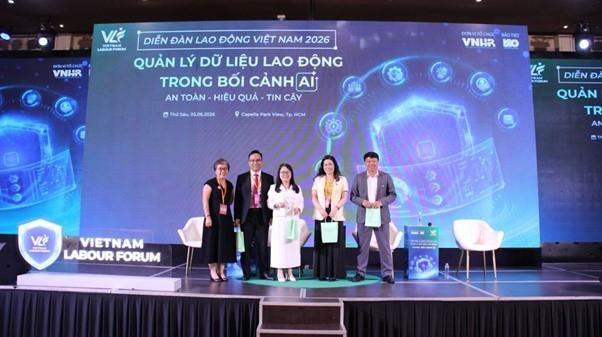
From regulatory analysis under Decree 337/2025/ND-CP to hands-on deployment experience, FPT brought a comprehensive perspective and practical solutions to help organizations prepare for the digitization of employment relationships and workforce data governance in this new phase.
The adoption of electronic labor contracts under the new regulatory framework attracted significant attention at the forum, given its dual impact: meeting legal compliance requirements while directly improving operational efficiency and the employee experience.
Vietnam Labor Forum 2026 is organized by VNHR, Vietnam's HR community with more than 1,200 members from over 600 organizations, and convened more than 500 enterprise leaders and HR, legal, and technology professionals from across the country. The event centered on issues of particular concern to the business community, including labor law updates, AI applications in human resource management, workforce data security, and the digital transformation of HR operations.
During the panel session "Electronic Labor Contracts: Optimization or Risk?", technology experts, legal practitioners, and HR leaders discussed the key considerations enterprises face when adopting electronic labor contracts, from the legal validity of digitally executed agreements to identity verification, data security, and electronic evidence management.
According to the panelists, Decree 337/2025/ND-CP has established a clearer legal framework for electronic labor contracts. Beyond recognizing their legal validity, the decree sets concrete requirements for identity verification, authentication, data storage, and workforce data security. This is precisely why many organizations are actively seeking solutions that satisfy compliance requirements while also ensuring operational efficiency and a positive employee experience.

Mr. Nguyen Ta Anh, Deputy Director of the Enterprise Digital Solutions Center at FPT IS, FPT Group, emphasized that electronic labor contracts are not simply a tool for meeting new legal requirements, they directly lay the foundation for digital enterprise governance. Digitizing the entire contract lifecycle, from creation and execution through storage and retrieval, enables organizations to improve operational efficiency, substantially reduce manual workloads, and unlock stronger workforce data governance and utilization.
Drawing on deployment experience across manufacturing, retail, logistics, services, and financial sectors, FPT observed that large-scale employers are increasingly prioritizing the transition from paper-based records to digital workforce management driven by the need to optimize costs, improve the employee experience, and enhance operational transparency.
The panelists also acknowledged common concerns among organizations implementing the decree, agreeing that each enterprise needs a transition roadmap tailored to its operational model and workforce profile, and should select a solution that is compliant, straightforward to deploy, and capable of integrating with existing systems.
On the question of technology accessibility for frontline workers in manufacturing, retail, and service industries, Mr. Nguyen Ta Anh noted that today's electronic signing solutions have been substantially simplified in terms of user interaction.
At the exhibition area, FPT demonstrated FPT.eContract as part of its digital HR solutions ecosystem, under the positioning "Next-Generation Electronic Labor Contract Platform, Compliant with Decree 337/2025/ND-CP." Visitors experienced the complete end-to-end electronic labor contract process firsthand in a live digital environment.
Through FPT.eContract, organizations can generate and execute labor contracts in bulk directly from HR data, monitor processing status in real time, and manage employee records centrally on a unified platform. Employees can receive, review, and sign contracts remotely from a mobile device, no in-person meeting is required.
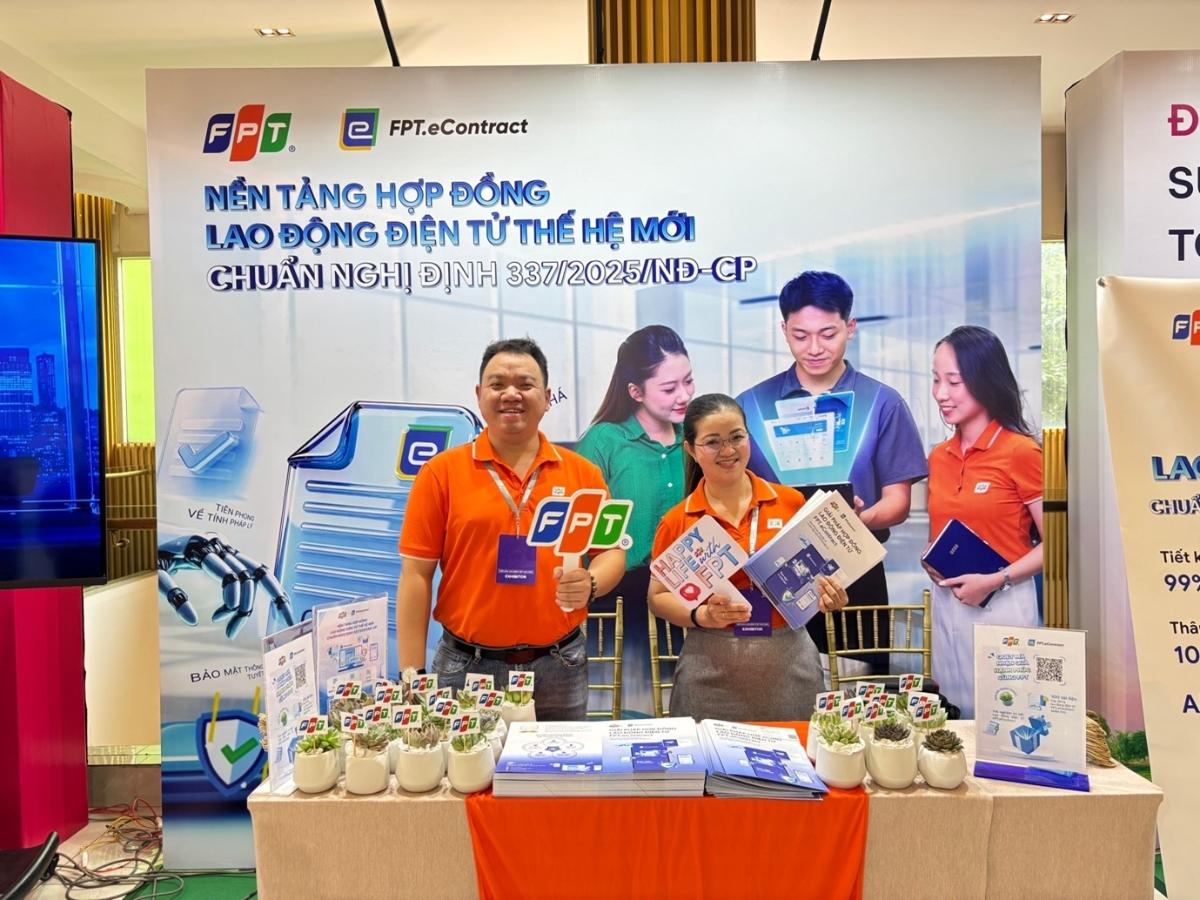
The solution integrates eKYC electronic identity verification, biometric authentication, and digital certificate issuance within a single closed-loop workflow, ensuring both legal validity and data security. The entire signing process is simplified with no additional application installation required, and the platform connects with HRM, ERP, and SAP systems for seamless HR data synchronization.
Built in accordance with the requirements of Decree 337/2025/ND-CP, FPT.eContract meets the prescribed standards for identity verification, authentication, digital signing, data storage, and security. The platform is also ready to connect with the state-designated electronic labor contract infrastructure, supporting a smooth transition from paper-based records to digital workforce governance.
With a comprehensive digital HR solutions ecosystem and deep ownership of core technology, FPT is ready to partner with the business community in building modern workforce management models, unlocking the full value of labor data, and adapting to the evolving technological and regulatory landscape of the AI era.


